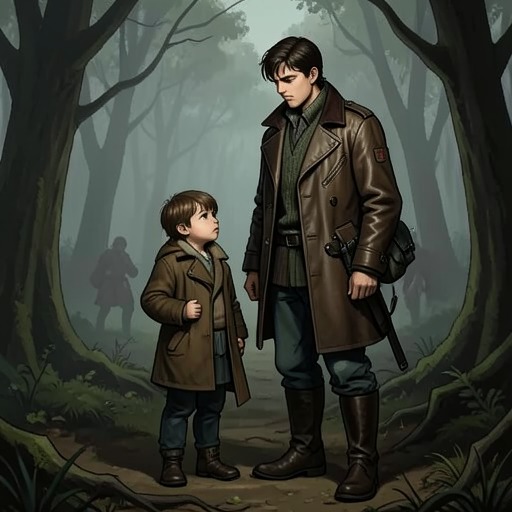
Borka’s band faces winter food shortages
Ronja, the Robber's DaughterBorka’s band faces winter food shortages because its move to Matt’s Fort leaves it without the livestock and adequate provisions on which it had relied. The scarcity makes Birk visibly weak, but it also draws Ronia into a sustained, secret effort to keep him and his family supplied. Her response turns food into more than relief: it becomes a practical expression of their chosen sibling bond across the division between the two robber bands.
Causes and Conditions
Birk tells Ronia that nobody in Borka’s band has been eating enough for a long time, and that their remaining food is running out. He fears that if spring does not arrive soon, they will not survive. Ronia initially has trouble taking in the extent of the shortage; she has seen the plentiful stores at Matt’s Fort and must understand that Birk’s household lives in a very different condition.
The band’s poverty follows its arrival at Matt’s Fort. Before the move, its members had goats and sheep; afterward, they have only their horses, which they have left for the winter with a farmer beyond Borka’s Forest. Birk says that keeping the horses there spared the band from having to eat them. Their provisions—some flour, turnips, peas, and salted fish—are now dwindling as well. Even obtaining water is difficult: the stream can be buried beneath snow, so the robbers sometimes melt snow instead, and carrying water up a rope ladder during a snowstorm adds another hardship.
The contrast is clearest when Ronia remembers the larder at Matt’s Fort. Lovis’s stores include bread, cheeses, eggs, salted food and smoked mutton, as well as flour, grain, peas, honey, nuts, and gathered herbs. Borka’s band, by contrast, is reduced to diminishing supplies and inadequate water. Ronia feels that the trouble is partly her fault and partly the fault of Matt’s Fort, linking the scarcity to the conflict and displacement that have separated the two households.
Birk’s Hunger and Ronia’s First Gift
When Ronia sees Birk, she notices that he has grown thin and that his face looks haggard. He says he has eaten little, though he has had more than anyone else in Borka’s Keep. Once she understands that the band has not had enough food for a long time, she opens her leather bag and gives him bread. Birk eats the coarse pieces at once, then drinks the jar of milk Ronia offers until it is empty. His absorption in the food makes the need unmistakable; afterward, he asks whether she should have kept it for herself.
Ronia is not offering food because she thinks Birk’s family is blameless or because the bands have made peace. She responds to the immediate fact of his hunger and to the relationship she now recognizes between them. When he jokes about being poor, dirty, and lice-ridden, she tells him that these things do not matter to her, but that she does not want him to be hungry. Birk, in turn, worries that he could have saved some bread for Undis. His concern points beyond his own need to the family whose stores are failing.
A Winter of Secret Provisioning
Ronia promises to return, and she keeps that promise. Throughout the remaining winter, she meets Birk early every morning in the cellar vaults and brings food from Lovis’s larder. The assistance is repeated and deliberate: she also gives him a bag of flour and a bag of peas each day, so he can secretly add them to Undis’s store. The daily delivery supplies both Birk and his family, rather than treating his first meal as a single, finished act of help.
The exchange creates discomfort as well as relief. Birk sometimes feels that accepting the gifts is like stealing from Ronia. She answers by turning her own inheritance into a pointed joke: as a robber’s daughter, she can steal too. She has learned that a robber takes without asking permission, and she applies that lesson to her own actions, urging Birk to eat. Her words do not erase the difference between taking from travelers and choosing to feed someone; instead, the contrast exposes how differently the same act of taking can function when it is directed toward care.
The secrecy matters because Ronia fears what Matt would think if he learned she was keeping Borka’s robbers alive. Yet she continues. In Birk’s report, Undis is amazed that a little flour and a few peas remain in the bins from one day to the next and suspects some kind of sorcery. The concealed additions quietly change the household’s prospects: Birk gradually looks more like himself and loses his famished appearance, a change that pleases Ronia.
From Scarcity to Kinship
The food shortage tests the bond between Ronia and Birk in concrete terms. Their connection is not expressed only through affection or shared time; Ronia accepts the risk of helping a household belonging to the rival band and turns supplies from Matt’s larder into daily provisions for Birk and Undis. Birk’s reluctance to accept the gifts, and his thought for his mother even while hungry, make the exchange reciprocal in feeling without making it equal in material terms. Ronia gives food; Birk receives it with gratitude and concern for the cost to her.
That concern for others echoes the wider ethic Ronia articulates in the forest. When Birk challenges her claim to the fox cubs and to the woods, he insists that the woods belong to all living things, including foxes, wolves, bears, elk, wild horses, birds, insects, and other forest creatures. Later, in spring, Ronia and Birk sit among birds, fox cubs, squirrels, hares, and a snake without disturbing one another; Ronia accepts that spring is for everyone. Against this broader recognition that life is not hers to own, the winter gifts show a related change in human terms: the enemy household’s need is no longer something she can dismiss as someone else’s concern.
The shortage itself does not resolve the feud, and the food deliveries do not constitute a formal agreement between the bands. Their significance is smaller and more intimate: through a winter of daily, hidden acts, Ronia makes her claim that Birk is her brother materially real. When Matt later asks Birk to return to Matt’s Fort because Ronia loves him and Matt may learn to do so as well, the invitation begins to loosen the separation between the households. The earlier provisioning has already shown what that change means at its most immediate level: Birk and his family are no longer merely the other band to Ronia; they are people whose hunger calls for her response.